
Preservation Facelift: Understanding Histocentricity and the Evolution of the MAERCKS Lift

What Is a Preservation Facelift?
As facial rejuvenation continues to evolve, increasing attention is being placed on techniques that consider the face as an interconnected anatomical structure rather than treating individual signs of ageing in isolation. One term gaining attention in this field is preservation facelift.
A preservation facelift generally describes an approach to facial rejuvenation that prioritises the preservation of natural facial anatomy and tissue relationships, with the aim of achieving balanced, natural-looking results.
The skin, underlying soft tissues and retaining ligaments all contribute to facial shape, support and expression. As these structures change with age, the relationship between them can influence the appearance of the cheeks, jawline, lower face and neck.
Understanding these relationships is an important part of surgical planning. Rather than focusing exclusively on tightening the skin, facial rejuvenation involves considering the underlying structures that contribute to the face's overall appearance.
At The Maercks Institute in Miami, Dr Rian A. Maercks approaches facial rejuvenation through a tissue-centred philosophy known as histocentricity.
What Is Histocentricity?
Histocentricity is the principle behind Dr Maercks’ approach to understanding facial anatomy and its role in facial rejuvenation. Developed in 2008, this philosophy places emphasis on the organisation, relationships and integrity of the facial tissue layers.
The face is made up of several interconnected structures, including the skin, subcutaneous tissues, deeper supporting layers and retaining ligaments. These structures work together to influence facial contour, movement and support.
Understanding how they interact helps inform decisions about how facial tissues may be repositioned and supported during surgery.
A histocentric approach considers these relationships as part of the wider anatomical picture. It recognises that facial rejuvenation requires an understanding of the structures beneath the skin, as well as the visible changes associated with ageing.
For Dr Maercks, histocentricity represents more than a description of a surgical technique. It is a guiding philosophy that informs how he evaluates facial anatomy and considers the relationship between different areas of the face.
How Has the Approach to Facial Rejuvenation Evolved?
Facelift surgery has developed considerably over time, with different techniques placing emphasis on different tissue layers, surgical planes and methods of support.
Traditional approaches often focused heavily on skin tightening, while modern techniques may involve repositioning deeper tissues to address changes in facial structure.
Deep plane facelift surgery, for example, involves working within a deeper anatomical plane to reposition facial tissues. Preservation facelift is a broader term associated with approaches that seek to maintain natural anatomical relationships and minimise unnecessary disruption where appropriate.
Although these terms may overlap in some respects, they are not interchangeable. The precise surgical technique, the structures involved and the intended outcomes depend on the surgeon's approach and the individual patient.
Histocentricity reflects Dr Maercks’ focus on understanding the relationships between facial tissues. This philosophy has continued to inform his approach to facial rejuvenation and the development of the MAERCKS Lift.
From Histocentricity to the MAERCKS Lift
The MAERCKS Lift represents the application of Dr Maercks’ approach to facial rejuvenation, informed by an emphasis on facial anatomy, tissue relationships and structural support.
Rather than considering the midface, lower face and neck as entirely separate areas, facial rejuvenation can involve assessing how these regions relate to one another. Changes in one area may influence the overall balance and proportions of the face.
Surgical planning therefore requires consideration of the patient's individual anatomy, degree of facial ageing, tissue characteristics and aesthetic goals.
The MAERCKS Lift reflects this broader perspective, with an emphasis on evaluating the face as an interconnected anatomical system.
For patients researching preservation facelift surgery, understanding the philosophy behind a procedure can provide useful context. However, the name of a technique alone does not determine its suitability or expected results. A consultation is necessary to discuss the specific surgical approach, potential benefits, limitations and risks.
The History of Histocentricity: A Timeline
Understanding the development of a surgical philosophy involves looking at its origins and how it has informed subsequent approaches to facial rejuvenation.
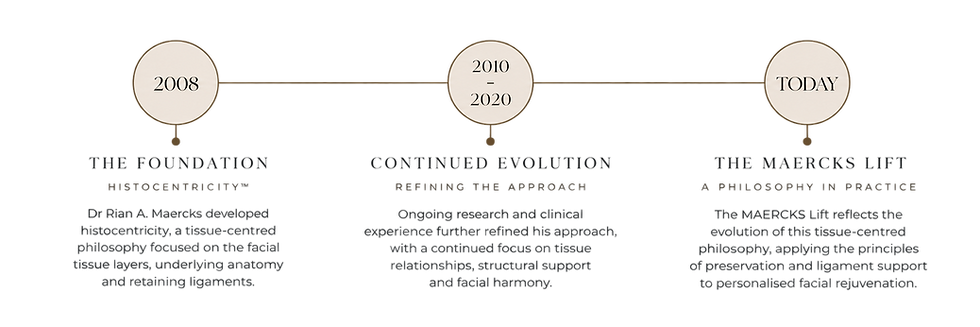
2008: The Foundation of Histocentricity
Dr Rian A. Maercks identifies 2008 as the starting point for his histocentric philosophy. The approach centres on the importance of facial tissue layers, underlying anatomy and the relationships between supporting structures.
This tissue-centred perspective informs the way facial ageing and surgical planning are considered at The Maercks Institute.
Continued Evolution: Refining the Approach
Over time, facial rejuvenation techniques have continued to develop, with increasing attention to the role of deeper tissues, retaining ligaments and the relationship between different facial regions.
The ongoing development of surgical approaches highlights the importance of understanding anatomy when planning facial rejuvenation. Specific milestones in the development of Dr Maercks’ technique should be considered alongside documented clinical and historical evidence.
Today: The MAERCKS Lift
Today, the MAERCKS Lift reflects the application of Dr Maercks’ tissue-centred philosophy to facial rejuvenation.
The approach considers facial structure and the relationship between anatomical layers as part of individualised surgical planning. The objective is to assess each patient's features and goals before determining which procedure may be appropriate.
For patients exploring facelift options, this history provides context for understanding the philosophy behind the MAERCKS Lift and its relationship to Dr Maercks’ wider approach to facial anatomy.
Preservation Facelift vs. Deep Plane Facelift: What Is the Difference?
Patients researching facelift surgery may encounter the terms preservation facelift and deep plane facelift when comparing surgical options.
A deep plane facelift refers to a surgical technique involving a deeper plane of facial tissue. Depending on the procedure, this may involve repositioning deeper tissues and releasing selected retaining ligaments.
Preservation facelift, by comparison, is a broader descriptive term associated with approaches that prioritise the preservation of natural anatomy and tissue relationships.
The two concepts are not necessarily mutually exclusive. A surgeon's specific approach may incorporate principles associated with tissue preservation while also involving deeper surgical planes.
It is therefore important to look beyond terminology when comparing procedures. Patients should ask their surgeon which anatomical structures are involved, how the technique is performed, what recovery involves and which outcomes are realistic for their individual circumstances.
The most appropriate approach depends on factors including facial anatomy, skin and tissue characteristics, the degree of ageing, medical history and the patient's goals.
Why Does Understanding Facial Anatomy Matter?
Facial ageing is a complex process. Changes in skin quality, soft tissue volume, tissue support and underlying structures can occur at different rates and affect each person differently.
A detailed understanding of facial anatomy helps surgeons evaluate these changes and plan treatment according to the individual patient.
For patients, this means that choosing a facelift should involve more than selecting a procedure based on its name or popularity. It should include a discussion of the surgeon's experience, the proposed surgical method, the expected recovery period and the potential risks.
It is also important to understand that no surgical technique can stop the ageing process or guarantee a particular result. Outcomes vary, and all surgical procedures carry risks that should be discussed during a consultation.
At The Maercks Institute, the histocentric philosophy informs Dr Maercks’ perspective on facial rejuvenation and the role of underlying tissue relationships in surgical planning.
Exploring the MAERCKS Lift at The Maercks Institute
For individuals considering facelift surgery in Miami, learning about the philosophy behind a procedure can be a useful first step in making an informed decision.
The relationship between facial tissue layers, retaining ligaments and overall facial structure provides important context for understanding different approaches to facial rejuvenation.
Histocentricity represents the foundation of Dr Rian A. Maercks’ tissue-centred philosophy, while the MAERCKS Lift reflects its application to his approach to facial rejuvenation.
If you are considering a facelift and would like to understand which options may be suitable for your anatomy and goals, a consultation can provide an opportunity to discuss the available techniques, expected outcomes, recovery and associated risks.
Learn more about Dr Maercks’ approach to facial rejuvenation and explore the surgical options available at The Maercks Institute
The information in this article is for educational purposes only and does not constitute medical advice. Suitability for facelift surgery must be determined through an individual consultation with a qualified surgeon.



Comments